بِسْمِ اللّٰهِ الرَّحْمٰنِ الرَّحِیْمِ

Level 2 — Intermidiate

Aqeedah & Fiqh

Core Islamic beliefs (Aqeedah) and foundational Islamic jurisprudence (Fiqh). This course covers what Muslims believe and the basic rules governing daily worship and life.
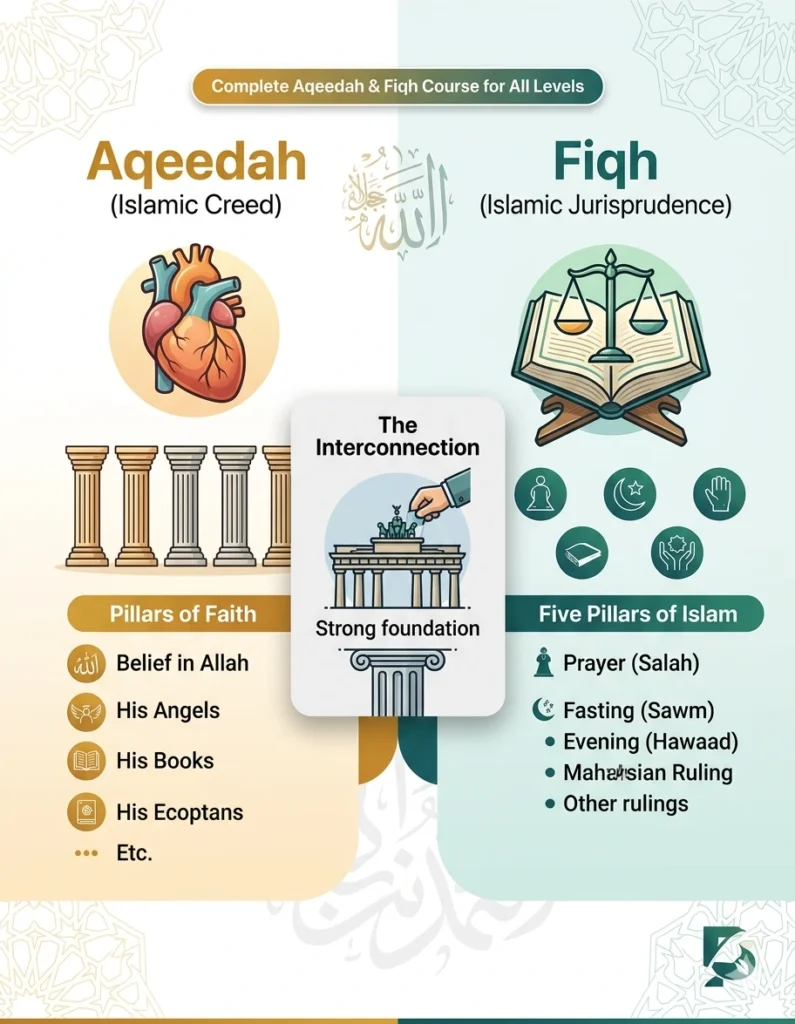
Online Aqeedah and Fiqh Course Online Islamic Studies Course Learn Aqeedah Online Online Fiqh Classes for Kids Islamic Jurisprudence Course Online

Course Overview:

Core Islamic beliefs (Aqeedah) and foundational Islamic jurisprudence (Fiqh). This course covers what Muslims believe and the basic rules governing daily worship and life.

Course Objectives:

By the end of this course, students will:
– Understand Islamic beliefs (Tawheed, attributes of Allah)
– Learn foundations of Islamic law and jurisprudence
– Understand rulings on purification (Tahara) and prayer
– Apply Islamic principles to daily decisions
– Understand different Islamic schools of thought
– Develop deeper connection with Islamic scholarship

Curriculum:

– Module 1: Islamic Beliefs (Aqeedah) – Tawheed and attributes of Allah – 10 lessons
– Module 2: Prophethood and the Messenger Muhammad ﷺ – 8 lessons
– Module 3: Introduction to Fiqh (Islamic jurisprudence) – 5 lessons
– Module 4: Fiqh of purification and prayer (Salah) – 12 lessons
– Module 5: Fiqh of fasting, Zakat, and Hajj – 10 lessons
– Module 6: Islamic schools of thought (Madhabs) – 5 lessons
– Module 7: Application and critical thinking – 10 lessons
– Module 8: Assessment and certification – 3 lessons

Course Details

Format:

2-5 days per week (30-minute sessions)

Duration:

14-18 weeks

Age Group:

8+

Prerequisite:

Basic Islamic Studies course recommended

Certificate:

Yes, on completion

Cost:

Starting at $35/month to $75/month

Online Quran Academy Reviews

Parent Reviews About Our Online Quran Academy

Families worldwide trust our Online Quran Academy for structured Quran learning, flexible scheduling, and certified tutors.

FAQs

Every Question You're Probably Thinking

Are the 3 free trial classes actually free, with no catch?

Yes — completely and entirely free. No payment required, no card taken, no commitment made. You attend 3 full classes with a certified tutor, and then decide if you want to continue. We do this because we are confident in our method. If after 3 classes you don't see clear value, we don't deserve your business.

Which Madhab (school of thought) do you teach for Fiqh?
We teach the foundational rulings agreed upon by the majority of mainstream orthodox scholars. If you follow a specific Madhab (Hanafi, Shafi'i, Maliki, Hanbali), please let us know during your trial, and we will align the curriculum accordingly.
Is this course too difficult for a 12-year-old? +
Not at all. Our tutors adapt the material to the student's age. For younger teens, we explain complex concepts using everyday examples, focusing on practical application rather than heavy academic theory.
Do I need prior Islamic knowledge to start? +
We recommend completing the "Basic Islamic Studies" course first, but if you already know how to pray and understand the basic pillars of Islam, you can jump straight into this intermediate course.
Will this course answer my questions about modern doubts in Islam? +
Yes. The Aqeedah portion of the course is specifically designed to fortify the mind. We address common modern questions, atheistic arguments, and social doubts using logical, Quranic frameworks.
Are the classes theoretical or practical? +
Both. Aqeedah is theoretical (what to believe in your heart), while Fiqh is highly practical (how to wash, how to pray, what invalidates a fast).
Can I ask personal Fiqh questions during the class? +
Absolutely. Our tutors are qualified to answer everyday Fiqh questions regarding your personal worship, purification, and daily habits.
Is Aqeedah based on a specific sect? +
We strictly teach mainstream Ahlus Sunnah wal Jama'ah Aqeedah, avoiding extreme or fringe ideologies.
How is the course assessed? +
We conduct informal, conversational assessments to ensure you understand the concepts, along with practical quizzes on Fiqh rulings (e.g., "What should you do if you forget the second prostration in Salah?").
What is the next step after finishing this course? +
Students usually progress to advanced Tafseer or Seerah & Hadith to see how these rules and beliefs were practically lived by the Prophet ﷺ and his companions.

Take Action

Begin Your Free Quran
Journey Today

Experience the QALBIAN difference. The first 3 classes are completely free. You are not committing to a subscription or providing card details until you are 100% satisfied.